The Future of AV
Scenario Authoring
Turning real-world logs into editable simulations for scalable Autonomous Vehicle training.
Executive Summary
From Raw Code to a Visual GUI
I led the UX evolution of Foretellix's Scenario Editor - progressively transforming a code-only engineering workflow into a visual, scenario-centric platform for autonomous vehicle testing. As UX Lead, I owned the full design process across multiple releases: from defining the interaction model and running research workshops with NVIDIA's team, through to pixel-perfect delivery and production QA.
Beyond the product itself, I managed and mentored a team of two designers, established UX ownership across the full product lifecycle, and built the design methodology that allowed the team to move fast without losing consistency across a complex, evolving platform.
Conceptual Unification
Led the transition from a read-only engineering debugger to an active composition tool - reframing the mental model for the entire product team in the process.
Design Leadership
Managed a team of 2 designers and coordinated with NVIDIA's West Coast UX Researchers, maintaining design consistency across both organisations.
Process & Methodology
Embedded code-bash workshops and early customer reviews into the design cycle, catching misalignment before development and reducing rework significantly.
Business Impact
Delivered the Northstar demo that secured full production UI ownership for Foretellix and expanded the NVIDIA Statement of Work.
KPIs & Strategic Impact
Measurable Results
Efficiency
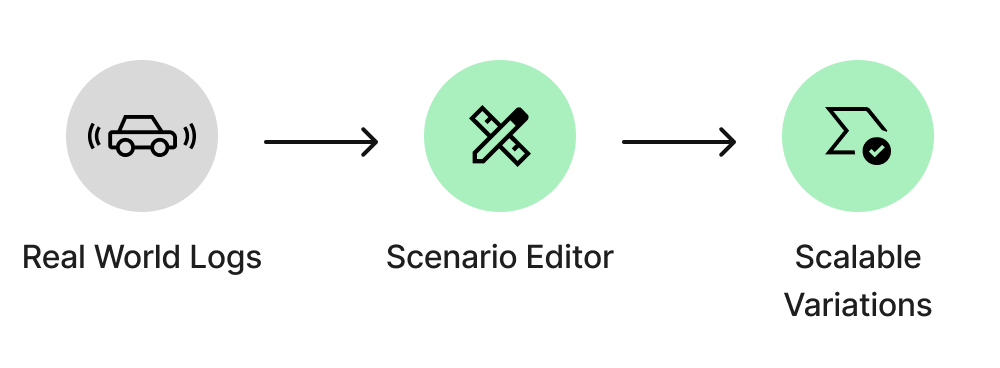
Reduced the time to create a complex corner-case scenario to just 10 minutes - down from a multi-hour, code-heavy process requiring deep technical expertise.
Scalability
Targets project 1.5x to 10x amplification in weekly scenario volume, enabled by the visual editing workflow replacing manual code authoring.
ROI
Significant compute savings by defaulting to low-fidelity previews during the iterative design phase, reducing unnecessary high-compute simulation runs.
Market Growth
The reusable UX pattern is now drawing active interest from other major OEMs - including Torc, Toyota, and BMW.
The full 6-stage SDG pipeline (Ingest, Denoise, Edit, Preview, Simulate, Export) was delivered to production across multiple releases, completing the first end-to-end synthetic data workflow for NVIDIA's AV safety operations.
The Problem & Persona
A Technical Tax Blocking Safety Experts
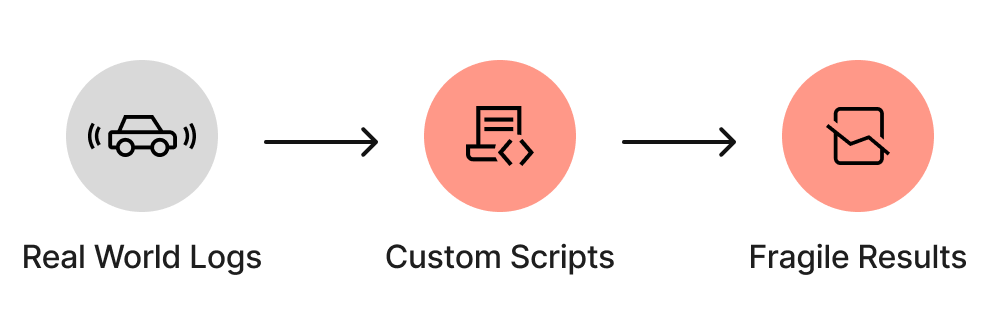
NVIDIA is moving toward AI-driven stacks that require learning from millions of miles of driving data. The existing workflow demanded deep technical expertise to author even a simple scenario - creating a barrier that blocked safety experts, Scenario Designers, and AV Developers from creating the variations they needed without engineering support.
The goal: scale scenario creation from 60 real-world logs to 1,000+.
Market Research
Benchmarking Industry Standards
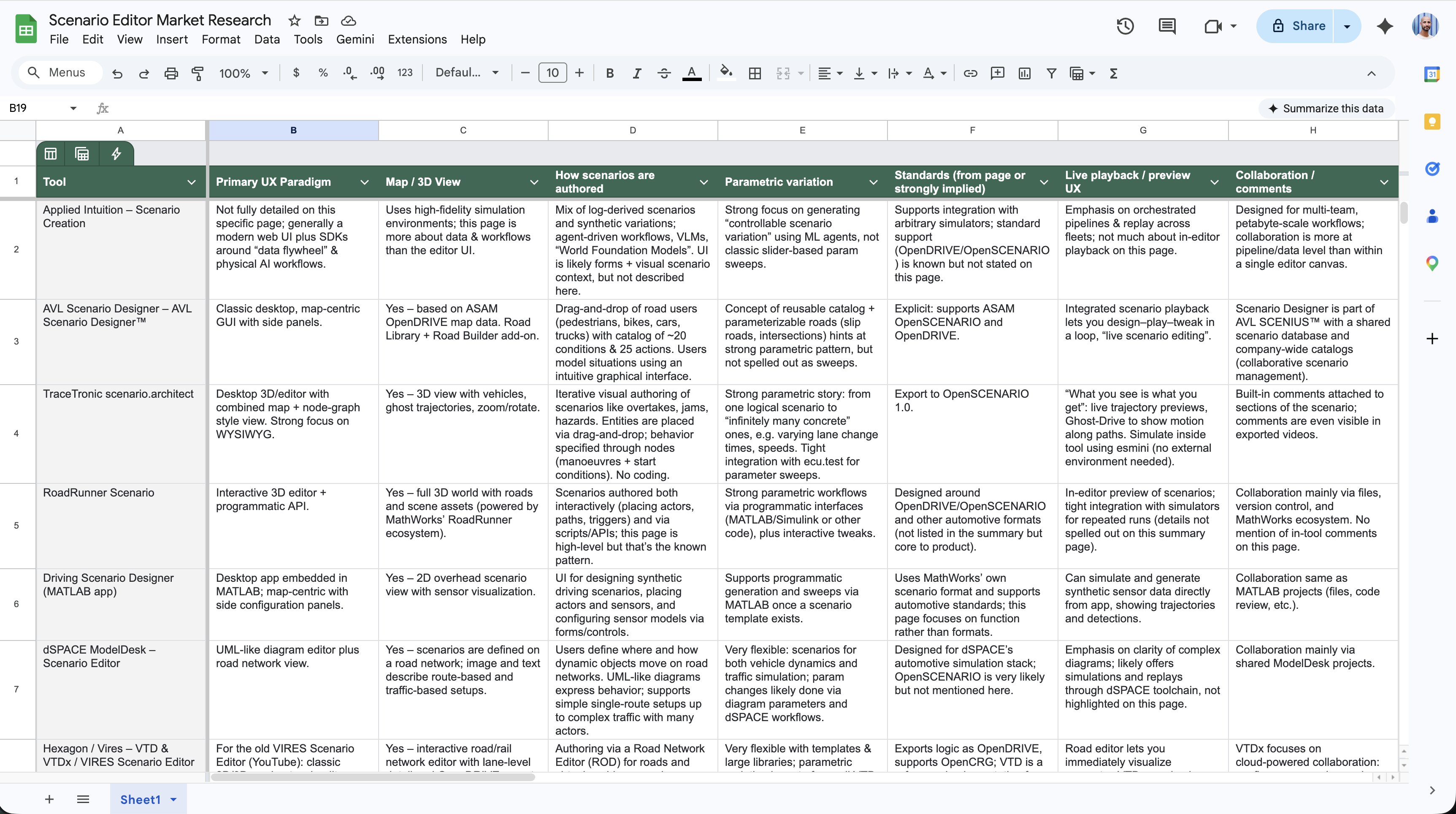
I conducted competitor research to benchmark industry standards and recurring UX patterns, identifying key opportunities to align with user expectations while differentiating our editor's experience.
Key takeaways:
- Combine map-first, WYSIWYG editing with structured modeling where complexity demands it.
- Prefer a web-based editor to maximise accessibility and sharing across teams.
- Design as part of a cloud loop: create, run at scale, analyse.
- Support standards-based import/export.
- Treat simulation at scale as a first-class UX need - scenarios should be easy to parameterise, batch, and debug.
The Solution
The SDG Scenario Editor
I architected the editor around three functional pillars to empower non-technical users:
- Ingestion & Cleaning - smoothing real-world noisy logs into stable simulations.
- Scenario Composition - a visual interface for adding synthetic actors and defining paths via waypoints without writing code.
- Graduated Fidelity Previews - instant fast previews for logic checks before escalating to high-compute simulations.

Feedback & Collaboration
Code-Bash Workshops & Continuous Loops
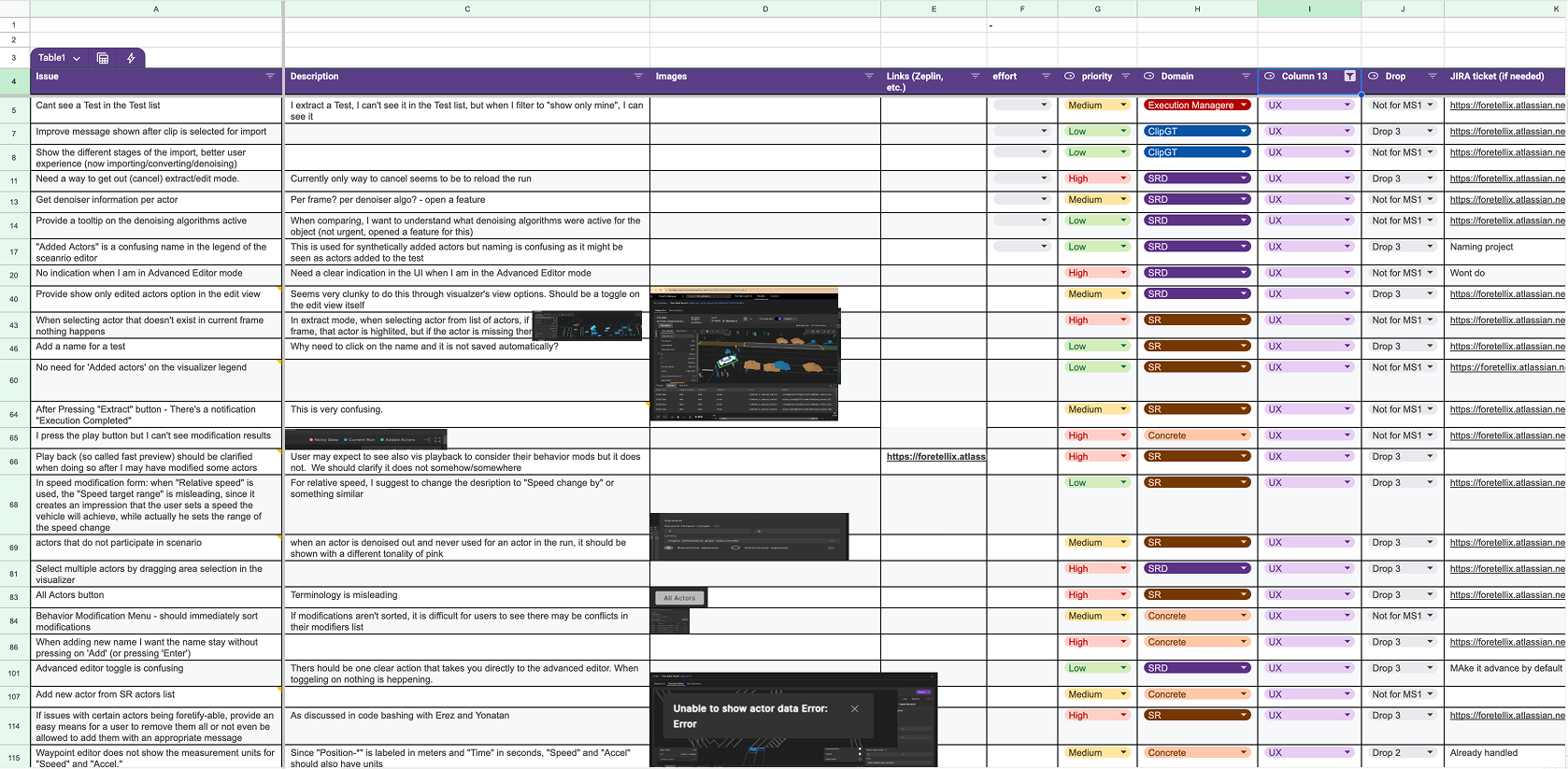
I translated NVIDIA interviews and "code-bash" workshops into clear mental models, maintaining a continuous feedback loop to ensure the experience stayed intuitive across a technically complex domain.
- Integrated Preview - moved previews directly into the editor using a dual-layer system for both instant playback and high-fidelity simulation.
- Execution Control - added granular configuration options, giving users precise manual control over individual simulation runs.
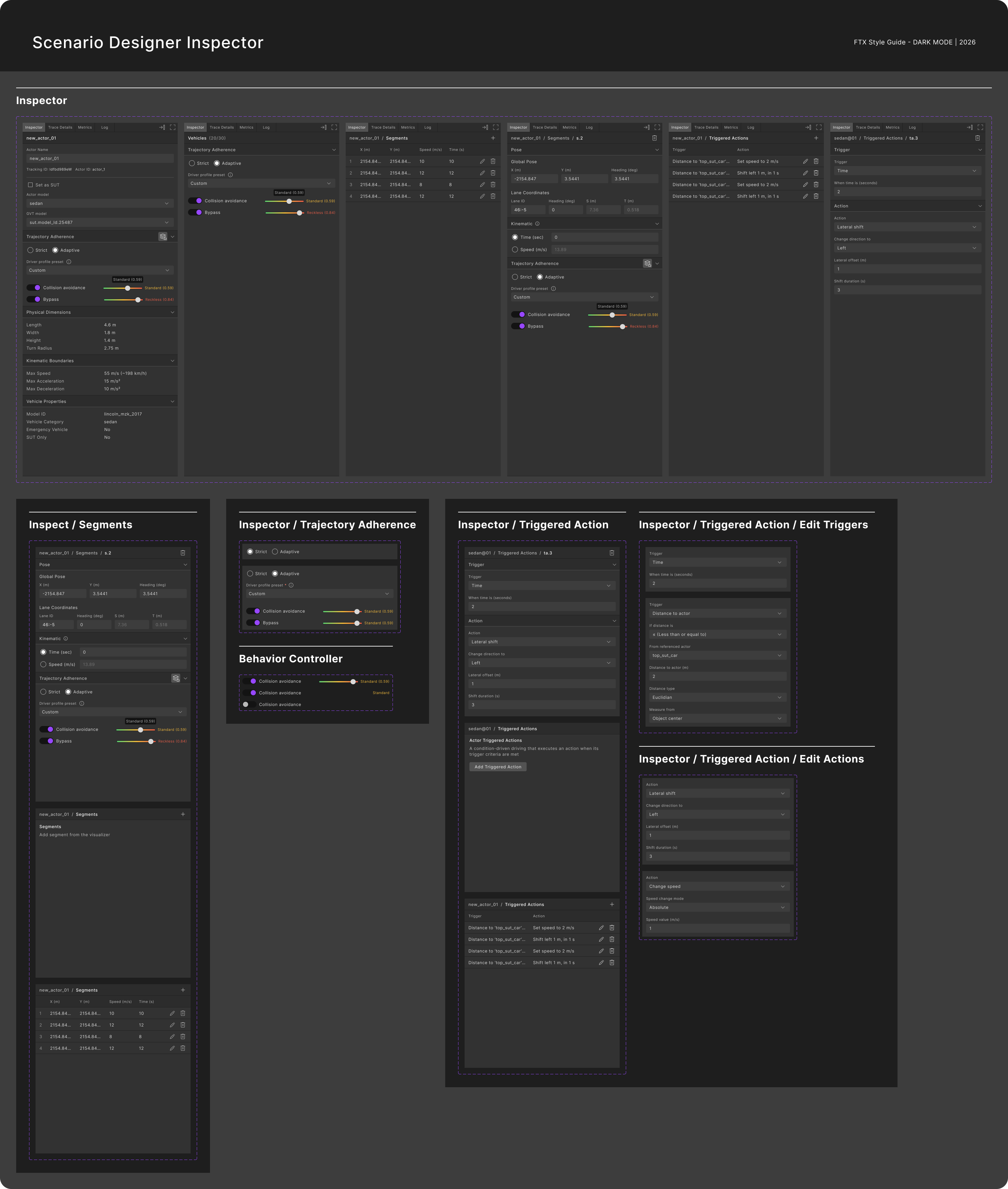
- Hierarchical Scalability - implemented a Scenario Tree architecture to help users navigate hundreds of actors and complex data without getting lost.
What's Next
From Foundation to Professional Mastery
With a high-speed, scriptless workflow established, I am evolving the tool into a professional-grade authoring environment focused on two strategic pillars:
- Hierarchical Scalability - a Scenario Tree architecture that mirrors the user's mental model, allowing navigation of hundreds of actors without getting lost in the data.
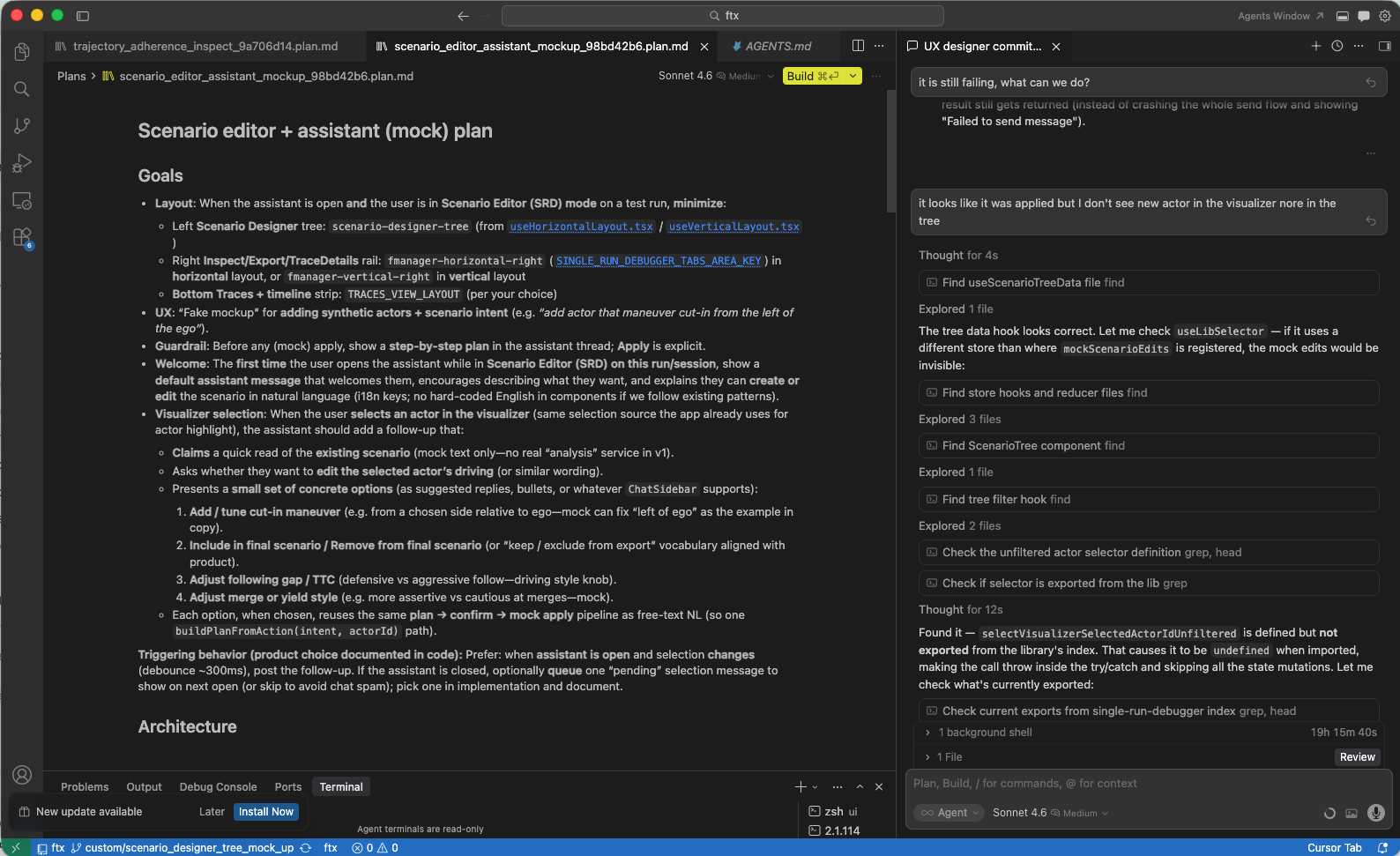
- AI-Augmented Authoring - a natural-language interface powered by Claude that lets users toggle between manual precision editing and a conversational "speaking builder" experience, generating complex scenes via prompts while retaining granular control.
Reflection
The Real Job of a UX Lead
Leading this project taught me that a UX Lead's real job is Conceptual Unification - bridging the gap between engineering rigour and designer-centric usability. The hardest work wasn't visual; it was getting engineers, product managers, and NVIDIA's domain experts to share the same mental model of what the tool should be and who it was for.
If I were starting again, I would have pushed for a clearer user segmentation earlier. "Non-technical user" is too broad a target - a Scenario Designer, an AV Developer, and a safety operations manager all have very different mental models of what a scenario is. Getting sharper on that distinction sooner would have saved several rounds of iteration.